

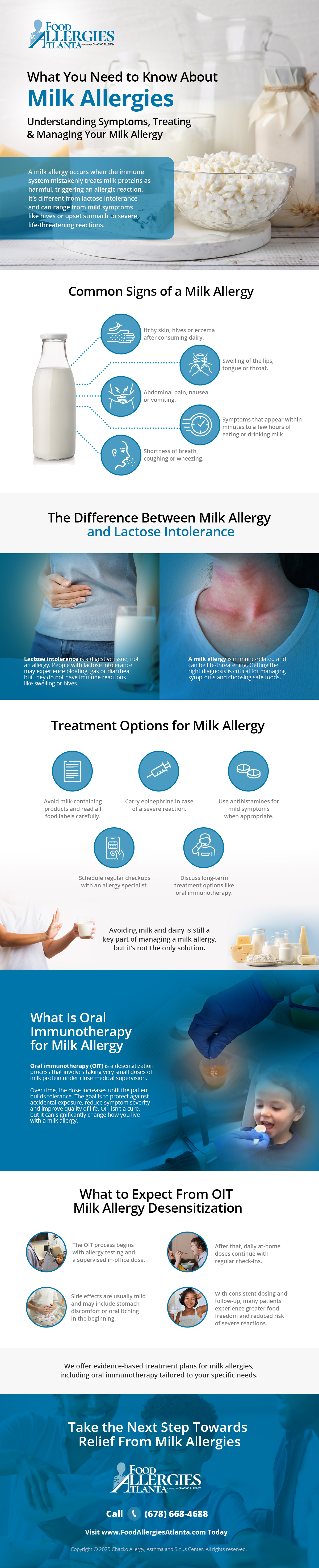
A milk allergy can be confusing to figure out on your own. With the help of your Atlanta allergist, you can get an accurate diagnosis and a proven milk allergy treatment plan. Below we’ll look at the main stages of the diagnosis and testing process. You can also browse our infographic for everything you need to know about milk allergies. Feel free to share it on your favorite social media platforms.
What Happens During Milk Allergy Testing and Diagnosis
Accurately diagnosing a milk allergy involves more than the testing procedures. Before recommending a treatment, allergists use the following methods to provide a precise diagnosis for adults and children.
Review Symptoms and Medical History
If you or your child have any concerning digestive, respiratory or skin issues after consuming dairy, you should see a food allergist to discuss milk allergy symptoms. Your allergist will ask about these symptoms, including how long after milk consumption they appeared. During this review you can also discuss any family history of food allergies.
Physical Examination
Your allergist may perform a physical examination to check for signs of allergic reactions. This examination will assess various symptoms that may suggest or rule out an allergy, such as nasal inflammation, eczema and more.
Milk Allergy Testing Procedures
If it’s possible that a milk allergy is the issue, patients will need to undergo milk allergy testing to see how the immune system reacts to this substance. Skin prick testing is the most common procedure used. During skin prick testing drops containing milk protein are placed on the arm, then the skin is lightly pricked to see if a red, raised bump forms. In some cases, blood testing will be the preferred test, particularly when skin testing is not the best choice due to eczema or medication use.
Oral Food Challenge for Milk Allergies
While not as common as skin prick or blood testing, an oral food challenge is considered to be the gold standard in allergy testing. For this test, patients consume gradually increasing amounts of milk to see how the body reacts. The oral food challenge takes place under medical supervision, and results will indicate if a person has an allergy, along with their level of sensitivity.
Assessing the Results to Reach a Diagnosis
After completing a medical and family history review, evaluation of symptoms, physical examination and allergy testing, your allergist will have the necessary information to diagnose a milk allergy. They can also rule out other conditions such as lactose intolerance, gastrointestinal sensitivities or other food allergies. The next stage is to develop a management plan that may include allergen avoidance, medication or oral immunotherapy treatment.
Understanding how milk allergies are diagnosed is just one aspect of living with an allergy. To learn about the symptoms, treatment and management of a milk allergy, take a look at our infographic below. You can also help others by sharing it across social media with the embed code below.
Comprehensive Milk Allergy Care in the Atlanta Area
For help diagnosing and treating a milk allergy, contact one of our Atlanta-area locations for assistance. We provide accurate food allergy testing and treatments for adults and children. Call (678) 668-4688 or request an appointment.
Share this Image On Your Site